An Instrument From the Chordophone Family Produces It's Sound From

Numerous stringed instruments of Chinese brand on brandish in a shop in Hong Kong
Cord instruments, stringed instruments, or chordophones are musical instruments that produce sound from vibrating strings when a performer plays or sounds the strings in some manner.
Musicians play some cord instruments by plucking the strings with their fingers or a plectrum—and others by hitting the strings with a calorie-free wooden hammer or by rubbing the strings with a bow. In some keyboard instruments, such as the harpsichord, the musician presses a fundamental that plucks the string. Other musical instruments generate audio by striking the string.
With bowed instruments, the player pulls a rosined horsehair bow beyond the strings, causing them to vibrate. With a hurdy-gurdy, the musician cranks a cycle whose rosined edge touches the strings.
Bowed instruments include the string section instruments of the Classical music orchestra (violin, viola, cello and double bass) and a number of other instruments (e.g., viols and gambas used in early music from the Baroque music era and fiddles used in many types of folk music). All of the bowed string instruments can besides exist plucked with the fingers, a technique called "pizzicato". A broad variety of techniques are used to sound notes on the electrical guitar, including plucking with the fingernails or a plectrum, strumming and even "tapping" on the fingerboard and using feedback from a loud, distorted guitar amplifier to produce a sustained sound. Some string instruments are mainly plucked, such every bit the harp and the electric bass. In the Hornbostel-Sachs scheme of musical instrument classification, used in organology, string instruments are chosen chordophones. Other examples include the sitar, rebab, banjo, mandolin, ukulele, and bouzouki.
According to Sachs,[one]
Chordophones are instruments with strings. The strings may exist struck with sticks, plucked with the bare fingers or a plectrum, bowed or (in the Aeolian harp, for instance} sounded by wind. The disruptive plentitude of stringed instruments can be reduced to four fundamental type: zithers, lutes, lyres, and harps.
In most string instruments, the vibrations are transmitted to the torso of the instrument, which often incorporates some sort of hollow or enclosed area. The trunk of the instrument also vibrates, forth with the air inside it. The vibration of the body of the instrument and the enclosed hollow or sleeping room brand the vibration of the string more audible to the performer and audience. The body of most string instruments is hollow. Some, even so—such as electric guitar and other instruments that rely on electronic amplification—may have a solid wood body.
Classification [edit]
In musicology, string instruments are known as chordophones. Information technology is one of the five main divisions of instruments in the Hornbostel-Sachs scheme of musical instrument nomenclature.
Hornbostel-Sachs divides chordophones into two principal groups: instruments without a resonator as an integral office of the instrument (which accept the classification number 31, also known equally simple); and instruments with such a resonator (which have the classification number 32, likewise known as composite). Most western instruments fall into the second group, but the pianoforte and harpsichord autumn into the offset. Hornbostel and Sachs' criterion for determining which sub-group an instrument falls into is that if the resonator tin can exist removed without destroying the musical instrument, then it is classified equally 31. The idea that the piano's casing, which acts as a resonator, could be removed without destroying the instrument, may seem odd, simply if the activeness and strings of the pianoforte were taken out of its box, it could still be played. This is non true of the violin, because the string passes over a span located on the resonator box, then removing the resonator would mean the strings had no tension.
Curt Sachs also broke chordophones into four basic subcategories, "zithers, lutes, lyres and harps."[2]
- Zithers include stick zithers such as the musical bow, tube zithers with a tube as the resonator such every bit the valiha, raft zithers in which tube zithers are tied into a unmarried "raft," lath zithers including clavichord and piano and dulcimer, and long zithers (described as combination of half-tube and board zithers) including Se and Guzheng families.
- Lutes are stringed musical instruments that include a body and "a neck which serves both equally a handle and as a means of stretching the strings beyond the body."[three] The lute family includes not only brusk-necked plucked lutes such equally the lute, oud, pipa, guitar, citole, gittern, mandore, rubab, and gambus and long-necked plucked lutes such as the tanbura, swarabat, bağlama, bouzouki, veena, theorbo, archlute, pandura, sitar, setar, merely besides bowed instruments such as the Yaylı tambur, rebab, erhu, and entire family of viols and violins.[3]
- The Lyre has two arms, which take a "yoke" or crossbar connecting them, and strings between the crossbar and the soundboard.[ii] Sachs divided this into the box lyre such as the Greek kithara and the bowl lyre which used a bowl on its side with skin soundboard.[2]
- The harp which has strings vertical to the soundboard.[ii]
Earliest string instruments [edit]
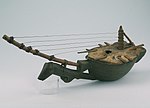
Bow Harp or Harp Lute, W Africa

Musical bows have survived in some parts of Africa.
Dating to around c. 13,000–BC, a cave painting in the Trois Frères cave in France depicts what some believe is a musical bow, a hunting bow used as a single-stringed musical instrument.[4] [five] From the musical bow, families of stringed instruments developed; since each string played a single note, adding strings added new notes, creating bow harps, harps and lyres.[6] In turn, this led to being able to play dyads and chords. Another innovation occurred when the bow harp was straightened out and a bridge used to elevator the strings off the stick-neck, creating the lute.[seven]
This pic of musical bow to harp bow is theory and has been contested. In 1965 Franz Jahnel wrote his criticism stating that the early on ancestors of plucked instruments are not currently known.[viii] He felt that the harp bow was a long weep from the composure of the civilizations of western Asia in 4000 BC that took the primitive technology and created "technically and artistically well-made harps, lyres, citharas, and lutes."[8]
Archaeological digs take identified some of the primeval stringed instruments in Ancient Mesopotamian sites, similar the lyres of Ur, which include artifacts over three m years sometime. The development of lyre instruments required the technology to create a tuning mechanism to tighten and loosen the string tension. Lyres with wooden bodies and strings used for plucking or playing with a bow stand for key instruments that indicate towards later on harps and violin-type instruments; moreover, Indian instruments from 500 BC take been discovered with anything from 7 to 21 strings.
Lutes [edit]
- See: History of lute-family instruments

Hellenistic banquet scene from the 1st century AD, Hadda, Gandhara. Lute player far right.
Musicologists have put forth examples of that fourth-century BC engineering, looking at engraved images that have survived. The earliest epitome showing a lute-like instrument came from Mesopotamia prior to 3000 BC.[10] A cylinder seal from c. 3100 BC or earlier (now in the possession of the British Museum) shows what is thought to be a woman playing a stick lute.[10] [11] From the surviving images, theorists take categorized the Mesopotamian lutes, showing that they developed into a long variety and a short.[12] The line of long lutes may have adult into the tamburs and pandura.[xiii] The line of brusque lutes was further developed to the due east of Mesopotamia, in Bactria, Gandhara, and Northwest India, and shown in sculpture from the 2nd century BC through the 4th or fifth centuries Advertizing.[14] [fifteen] [16]
During the medieval era, instrument development varied in different regions of the earth. Middle Eastern rebecs represented breakthroughs in terms of shape and strings, with a half a pear shape using three strings. Early on versions of the violin and fiddle, by comparison, emerged in Europe through instruments such as the gittern, a four-stringed precursor to the guitar, and basic lutes. These instruments typically used catgut (animal intestine) and other materials, including silk, for their strings.
Renaissance to modern [edit]
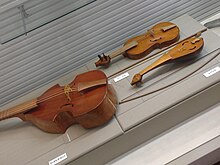
Viol, fidel and rebec (from left to right) on display at Amakusa Korejiyokan in Amakusa, Kumamoto, Japan
String musical instrument blueprint was refined during the Renaissance and into the Baroque menstruation (1600–1750) of musical history. Violins and guitars became more than consistent in design and were roughly similar to audio-visual guitars of the 2000s. The violins of the Renaissance featured intricate woodwork and stringing, while more than elaborate bass instruments such as the bandora were produced alongside quill-plucked citterns, and Spanish body guitars.
In the 19th century, cord instruments were fabricated more widely bachelor through mass production, with wood string instruments a key part of orchestras – cellos, violas, and upright basses, for instance, were now standard instruments for chamber ensembles and smaller orchestras. At the same time, the 19th-century guitar became more typically associated with half-dozen-cord models, rather than traditional five-string versions.
Major changes to string instruments in the 20th century primarily involved innovations in electronic instrument amplification and electronic music – electric violins were bachelor by the 1920s and were an important part of emerging jazz music trends in the United States. The acoustic guitar was widely used in blues and jazz, merely every bit an audio-visual instrument, it was non loud plenty to be a solo instrument, so these genres mostly used it every bit an accompaniment rhythm section musical instrument. In big bands of the 1920s, the acoustic guitar played backing chords, just it was non loud enough to play solos similar the saxophone and trumpet. The evolution of guitar amplifiers, which independent a power amplifier and a loudspeaker in a wooden chiffonier, let jazz guitarists play solos and be heard over a large band. The development of the electric guitar provided guitarists with an instrument that was congenital to connect to guitar amplifiers. Electric guitars have magnetic pickups, volume control knobs and an output jack.
In the 1960s, larger, more powerful guitar amplifiers were developed, called "stacks". These powerful amplifiers enabled guitarists to perform in stone bands that played in big venues such every bit stadiums and outdoor music festivals (eastward.g., Woodstock Music Festival). Along with the development of guitar amplifiers, a large range of electronic effects units, many in small stompbox pedals were introduced in the 1960s and 1970s, such every bit fuzz pedals, flangers, and phasers enabling performers to create unique new sounds during the psychedelic stone era. Breakthroughs in electric guitar and basses technologies and playing styles enabled major breakthroughs in pop and rock music in the 1960s and 1970s. The distinctive sound of the amplified electric guitar was the centerpiece of new genres of music such equally dejection rock and jazz-rock fusion. The sonic power of the loudly amplified, highly distorted electric guitar was the key element of the early heavy metal music, with the distorted guitar being used in atomic number 82 guitar roles, and with ability chords as a rhythm guitar.
The ongoing utilise of electronic amplification and effects units in string instruments, ranging from traditional instruments like the violin to the new electric guitar, added diversity to contemporary classical music performances, and enabled experimentation in the dynamic and timbre (tone colour) range of orchestras, bands, and solo performances.[17]
Types of instruments [edit]

A adult female playing some kind of string instrument while riding a equus caballus, Tang dynasty
Construction [edit]
String instruments can be divided into three groups:
- Lutes
- Instruments that back up the strings via a neck and a bout ("gourd"), for example a guitar, a violin, or a saz
- Harps
- Instruments that contain the strings within a frame
- Zithers
- Instruments that accept the strings mounted on a body, frame or tube, such equally a guqin, a cimbalom, an autoharp, harpsichord, a piano, or a valiha
Information technology is as well possible to divide the instruments into categories focused on how the musical instrument is played.
Playing techniques [edit]

All string instruments produce sound from one or more vibrating strings, transferred to the air past the body of the instrument (or past a pickup in the case of electronically amplified instruments). They are usually categorised by the technique used to make the strings vibrate (or past the primary technique, in the case of instruments where more one may employ.) The three most common techniques are plucking, bowing, and striking. An important divergence between bowing and plucking is that in the former the phenomenon is periodic so that the overtones are kept in a strictly harmonic relationship to the fundamental.[18]
Plucking [edit]
Plucking is a method of playing on instruments such as the veena, banjo, ukulele, guitar, harp, lute, mandolin, oud, and sitar, using either a finger, thumb, or quills (now plastic plectra) to pluck the strings.
Instruments normally played by bowing (see below) may also be plucked, a technique referred to past the Italian term pizzicato.
Bowing [edit]
Bowing (Italian: arco) is a method used in some string instruments, including the violin, viola, cello, and the double bass (of the violin family unit), and the old viol family. The bow consists of a stick with a "ribbon" of parallel equus caballus tail hairs stretched between its ends. The hair is coated with rosin so it tin grip the string; moving the hair across a string causes a stick-slip phenomenon, making the string vibrate, and prompting the instrument to emit sound. Darker grades of rosin grip well in cool, dry climates, but may be too pasty in warmer, more humid weather. Violin and viola players generally use harder, lighter-colored rosin than players of lower-pitched instruments, who tend to favor darker, softer rosin.[nineteen]
The ravanahatha is one of the oldest string instruments. Ancestors of the modern bowed string instruments are the rebab of the Islamic Empires, the Persian kamanche and the Byzantine lira. Other bowed instruments are the rebec, hardingfele, nyckelharpa, kokyū, erhu, igil, sarangi, morin khuur, and K'ni. The hurdy-gurdy is bowed by a cycle. Rarely, the guitar has been played with a bow (rather than plucked) for unique effects.
Striking [edit]
The third common method of sound product in stringed instruments is to strike the string. The piano and hammered dulcimer use this method of sound production. Even though the piano strikes the strings, the use of felt hammers means that the sound that is produced can nevertheless be mellow and rounded, in dissimilarity to the sharp assail produced when a very hard hammer strikes the strings.
Violin family string instrument players are occasionally instructed to strike the string with the stick of the bow, a technique chosen col legno. This yields a percussive audio forth with the pitch of the notation. A well-known utilize of col legno for orchestral strings is Gustav Holst'south "Mars" motility from The Planets suite.
Other methods [edit]
The aeolian harp employs a very unusual method of sound production: the strings are excited by the movement of the air.
Some instruments that take strings have an attached keyboard that the role player presses keys on to trigger a mechanism that sounds the strings, instead of directly manipulating the strings. These include the pianoforte, the clavichord, and the harpsichord. With these keyboard instruments, strings are occasionally plucked or bowed by paw. Modern composers such as Henry Cowell wrote music that requires that the player accomplish inside the piano and pluck the strings direct, "bow" them with bow pilus wrapped around the strings, or play them by rolling the bell of a contumely instrument such equally a trombone on the array of strings. Withal, these are relatively rarely used special techniques.
Other keyed string instruments, small plenty for a strolling musician to play, include the plucked autoharp, the bowed nyckelharpa, and the hurdy-gurdy, which is played by cranking a rosined wheel.
Steel-stringed instruments (such as the guitar, bass, violin, etc.) can be played using a magnetic field. An Due east-Bow is a small-scale mitt-held battery-powered device that magnetically excites the strings of an electrical cord musical instrument to provide a sustained, singing tone reminiscent of a held bowed violin notation.
Third bridge is a plucking method where the role player frets a string and strikes the side opposite the bridge. The technique is mainly used on electric instruments because these take a pickup that amplifies simply the local string vibration. It is possible on acoustic instruments likewise, but less effective. For case, a player might press on the seventh fret on a guitar and pluck it at the caput side to make a tone resonate at the opposing side. On electric instruments, this technique generates multitone sounds reminiscent of a clock or bell.
Electric string instruments, such as the electric guitar, can also exist played without touching the strings by using audio feedback. When an electric guitar is plugged into a loud, powerful guitar amplifier with a loudspeaker and a high level of baloney is intentionally used, the guitar produces sustained high-pitched sounds. By changing the proximity of the guitar to the speaker, the guitarist tin produce sounds that cannot be produced with standard plucking and picking techniques. This technique was popularized past Jimi Hendrix and others in the 1960s. It was widely used in psychedelic stone and heavy metal music.
Changing the pitch of a vibrating cord [edit]
There are three means to change the pitch of a vibrating string. String instruments are tuned by varying a string's tension because adjusting length or mass per unit of measurement length is impractical. Instruments with a fingerboard are and then played past adjusting the length of the vibrating portion of the strings. The following observations all apply to a string that is infinitely flexible (a theoretical assumption, considering in applied applications, strings are non infinitely flexible) strung between two fixed supports. Existent strings have finite curvature at the bridge and nut, and the bridge, because of its motion, is not exactly nodes of vibration. Hence the following statements most proportionality are approximations.
Length [edit]

String fingering is proportional and not fixed,[xx] as on the piano
Pitch can be adapted by varying the length of the string.[18] A longer string results in a lower pitch, while a shorter string results in a higher pitch. A concert harp has pedals that cause a hard object to make contact with a string to shorten its vibrating length during a performance.[21] The frequency is inversely proportional to the length:

A string twice every bit long produces a tone of half the frequency (one octave lower).
Tension [edit]
Pitch can be adjusted by varying the tension of the string. A string with less tension (looser) results in a lower pitch, while a string with greater tension (tighter) results in a higher pitch. Pushing a pedal on a pedal steel guitar raises the pitch of certain strings by increasing tension on them (stretching) through a mechanical linkage; release of the pedal returns the pitch to the original. Knee levers on the instrument tin can lower a pitch by releasing (and restoring) tension in the same way.[22] A bootleg washtub bass fabricated out of a length of rope, a broomstick and a washtub can produce dissimilar pitches by increasing the tension on the rope (producing a higher pitch) or reducing the tension (producing a lower pitch). The frequency is proportional to the square root of the tension:

Linear density [edit]
The pitch of a string can also be varied by changing the linear density (mass per unit of measurement length) of the string. In practical applications, such every bit with double bass strings or bass pianoforte strings, extra weight is added to strings past winding them with metal. A string with a heavier metal winding produces a lower pitch than a string of equal length without a metal winding. This can exist seen on a 2016-era set of gut strings for double bass. The higher-pitched G string is often made of synthetic cloth, or sometimes animate being intestine, with no metal wrapping. To enable the depression E string to produce a much lower pitch with a string of the same length, it is wrapped with many wrappings of thin metal wire. This adds to its mass without making it too stiff. The frequency is inversely proportional to the foursquare root of the linear density:

Given two strings of equal length and tension, the string with higher mass per unit length produces the lower pitch.
Cord length or calibration length [edit]
The length of the string from nut to span on bowed or plucked instruments ultimately determines the altitude between different notes on the musical instrument. For example, a double bass with its low range needs a scale length of around 42 inches (110 cm), whilst a violin scale is only almost 13 inches (33 cm). On the shorter scale of the violin, the left paw may easily attain a range of slightly more than ii octaves without shifting position, while on the bass' longer scale, a single octave or a ninth is reachable in lower positions.
Contact points forth the string [edit]
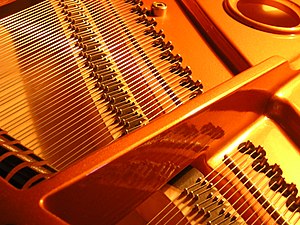
In bowed instruments, the bow is normally placed perpendicularly to the string, at a signal halfway between the terminate of the fingerboard and the bridge. Nevertheless, different bow placements can exist selected to change timbre. Application of the bow shut to the span (known as sul ponticello) produces an intense, sometimes harsh sound, which acoustically emphasizes the upper harmonics. Bowing above the fingerboard (sul tasto) produces a purer tone with less overtone force, emphasizing the primal, also known equally flautando, since information technology sounds less reedy and more flute-like.
Bowed instruments pose a challenge to instrument builders, as compared with instruments that are only plucked (e.g., guitar), because on bowed instruments, the musician must exist able to play i string at a time if they wish. Equally such, a bowed instrument must accept a curved bridge that makes the "outer" strings lower in height than the "inner" strings. With such a curved bridge, the player can select one string at a time to play. On guitars and lutes, the bridge can be apartment, considering the strings are played by plucking them with the fingers, fingernails or a pick; past moving the fingers or pick to different positions, the histrion tin can play different strings. On bowed instruments, the need to play strings individually with the bow besides limits the number of strings to about half dozen or seven strings; with more strings, it would be impossible to select individual strings to bow. (Note: bowed strings can also play ii bowed notes on two dissimilar strings at the aforementioned time, a technique called a double end.) Indeed, on the orchestral cord section instruments, 4 strings are the norm, with the exception of v strings used on some double basses. In contrast, with stringed keyboard instruments, 88 courses are used on a piano, and even though these strings are arranged on a flat bridge, the machinery tin can play any of the notes individually.
Similar timbral distinctions are also possible with plucked string instruments by selecting an appropriate plucking bespeak, although the difference is perhaps more than subtle.
In keyboard instruments, the contact point forth the cord (whether this be hammer, tangent, or plectrum) is a choice made by the musical instrument designer. Builders use a combination of experience and acoustic theory to establish the correct set of contact points.
In harpsichords, oft at that place are two sets of strings of equal length. These "choirs" ordinarily differ in their plucking points. One choir has a "normal" plucking bespeak, producing a canonical harpsichord audio; the other has a plucking point shut to the bridge, producing a reedier "nasal" sound rich in upper harmonics.
Product of multiple notes [edit]

A unmarried string at a certain tension and length simply produces one note. To produce multiple notes, string instruments utilise i of two methods. One is to add together enough strings to cover the required range of different notes (due east.thou., as with the piano, which has sets of 88 strings to enable the performer to play 88 unlike notes). The other is to provide a way to stop the strings along their length to shorten the function that vibrates, which is the method used in guitar and violin family instruments to produce different notes from the same string. The piano and harp represent the first method, where each note on the musical instrument has its own cord or course of multiple strings tuned to the same note. (Many notes on a piano are strung with a "choir" of three strings tuned alike, to increase the book.) A guitar represents the 2nd method—the histrion'southward fingers push button the string against the fingerboard and so that the string is pressed firmly against a metal fret. Pressing the string confronting a fret while plucking or strumming it shortens the vibrating part and thus produces a different annotation.
Some zithers combine stoppable (melody) strings with a greater number of "open" harmony or chord strings. On instruments with stoppable strings, such equally the violin or guitar, the thespian tin shorten the vibrating length of the string, using their fingers directly (or more rarely through some mechanical device, as in the nyckelharpa and the hurdy-gurdy). Such instruments usually have a fingerboard fastened to the neck of the instrument, that provides a difficult flat surface the role player can finish the strings against. On some cord instruments, the fingerboard has frets, raised ridges perpendicular to the strings, that end the string at precise intervals, in which case the fingerboard is also chosen a fretboard.
Moving frets during operation is usually impractical. The bridges of a koto, on the other hand, may be moved by the actor occasionally in the course of a unmarried piece of music. Many modern Western harps include levers, either straight moved by fingers (on Celtic harps) or controlled by foot pedals (on orchestral harps), to raise the pitch of individual strings by a fixed amount. The Middle Eastern zither, the qanun, is equipped with small levers called mandal that permit each course of multiple strings exist incrementally retuned "on the fly" while the instrument is being played. These levers enhance or lower the pitch of the string course by a microtone, less than a one-half step.
Sympathetic strings [edit]
Some instruments are employed with sympathetic strings—which are additional strings not meant to exist plucked. These strings resonate with the played notes, creating additional tones. Sympathetic strings vibrate naturally when various intervals, such every bit the unisons or the octaves of the notes of the sympathetic strings are plucked, bowed or struck. This system is used on the sarangi, the one thousand piano, the hardanger fiddle and the rubab.
Sound production [edit]
Audio-visual instruments [edit]

The Moroccan loutar uses a soundboard made of goatskin.
A vibrating string strung on a very thick log, as a hypothetical example, would brand only a very quiet audio, so string instruments are unremarkably synthetic in such a style that the vibrating string is coupled to a hollow resonating sleeping accommodation, a soundboard, or both. On the violin, for example, the four strings laissez passer over a thin wooden bridge resting on a hollow box (the body of the violin). The normal force applied to the torso from the strings is supported in part by a small cylinder of forest called the soundpost. The violin body also has two "f-holes" carved on the top. The strings' vibrations are distributed via the bridge and soundpost to all surfaces of the instrument, and are thus made louder by matching of the acoustic impedance. The correct technical explanation is that they allow a better match to the audio-visual impedance of the air.[ citation needed ]
Information technology is sometimes said that the sounding board or soundbox "amplifies" the sound of the strings. In reality, no ability amplification occurs, considering all of the energy to produce sound comes from the vibrating cord. The mechanism is that the sounding board of the instrument provides a larger surface area to create audio waves than that of the string and therefore acts as a matching element betwixt the acoustic impedance of the cord and that of the surrounding air. A larger vibrating surface tin can sometimes produce better matching; especially at lower frequencies.
All lute type instruments traditionally have a bridge, which holds the string at the proper activity height from the fret/finger board at one finish of the strings. On acoustic instruments, the bridge performs an as important function of transmitting string energy into the "sound box" of the instrument, thereby increasing the sound volume. The specific design, and materials used in the construction of the bridge of an instrument, have a dramatic impact upon both the audio and responsiveness of the instrument.
Achieving a tonal feature that is effective and pleasing to the histrion'due south and listener'south ear is something of an art and craft, as well as a scientific discipline, and the makers of string instruments ofttimes seek very high quality forest to this stop, specially spruce (called for its lightness, strength and flexibility) and maple (a very hard wood). Spruce is used for the sounding boards of instruments from the violin to the piano. Instruments such as the banjo use a pulsate, covered in natural or constructed pare as their soundboard.
Acoustic instruments can also be made out of bogus materials, such as carbon fiber and fiberglass (particularly the larger, lower-pitched instruments, such equally cellos and basses).
In the early 20th century, the Stroh violin used a diaphragm-type resonator and a metal horn to projection the cord sound, much like early on mechanical gramophones. Its utilise declined beginning about 1920, equally electronic amplification through power amplifiers and loudspeakers was developed and came into use. String instrument players tin can electronically amplify their instruments past connecting them to a PA system or a guitar amplifier.
Electronic amplification [edit]
Nearly cord instruments tin be fitted with piezoelectric[23] or magnetic pickups to convert the string's vibrations into an electrical signal that is amplified and then converted back into audio by loudspeakers. Some players attach a pickup to their traditional string instrument to "electrify" information technology. Another choice is to use a solid-bodied musical instrument, which reduces unwanted feedback howls or squeals.
Amplified string instruments tin can exist much louder than their audio-visual counterparts, so musicians can play them in relatively loud rock, blues, and jazz ensembles. Amplified instruments can besides accept their amplified tone modified by using electronic effects such every bit distortion, reverb, or wah-wah.
Bass-register string instruments such as the double bass and the electric bass are amplified with bass instrument amplifiers that are designed to reproduce depression-frequency sounds. To modify the tone of amplified bass instruments, a range of electronic bass effects are available, such as distortion and chorus.
Symphonic strings [edit]
The string instruments commonly used in the orchestra,[24] and often chosen the "symphonic strings" or string section are:[25]
- Violins (divided into two sections—commencement violins and 2nd violins; these sections play exactly the same instruments; the difference is that the first violins play higher-register lines and the second violins play lower-register parts, accompaniment parts or countermelodies)
- Violas
- Cellos
- Double basses
When orchestral instrumentation specifies "strings," it often means this combination of cord parts. Orchestral works rarely omit whatever of these string parts, but frequently include additional string instruments, especially the concert harp and pianoforte. In the Baroque orchestra from the 1600s–1750 (or with modern groups playing early on music) harpsichord is nearly always used to play the basso continuo part (the written-out bass line and improvised chords), and often a theorbo or lute or a piping organ. In some classical music, such equally the string quartet, the double bass is not typically used; the cello plays the bass role in this literature.
See also [edit]
- "Essay on the fingering of the violoncello and on the acquit of the bow"
- List of string instruments
- Luthier (maker of stringed instruments)
- Musical acoustics
- Ravanahatha
- Cord instrument extended technique
- Cord musical instrument repertoire
- String orchestra
- Strings (music)
- Stringed musical instrument tunings
References [edit]
- ^ Sachs, Curt (1940). The History of Musical Instruments, p.463. Westward. Due west. Nortan & Visitor, Inc. ISBN 0-393-02068-ane
- ^ a b c d Sachs, Short (1940). The History of Musical Instruments . New York: Due west. W. Norton & Company. pp. 463–467. ISBN9780393020687.
- ^ a b Sachs, Curt (1940). The History of Musical Instruments . New York: West. W. Norton & Company. p. 464. ISBN9780393020687.
- ^ Campen, Ank van. "The music-bow from prehistory till today". HarpHistory.info. Archived from the original on April two, 2015. Retrieved March 26, 2015.
A cave-painting in the "Trois Frères" cave in France dating from nigh 15,000 years agone. The magician-hunter plays the musical bow.
- ^ "Trois Freres Cavern". Archived from the original on March 18, 2015. Retrieved March 27, 2015.
- ^ Dumbrill 1998, pp. 179, 231, 235–236, 308–310 harvnb error: no target: CITEREFDumbrill1998 (help) [ incomplete short commendation ]
- ^ Dumbrill 1998, pp. 308–310 harvnb error: no target: CITEREFDumbrill1998 (help)
- ^ a b Jahnel, Franz (1965). Manual of Guitar Technology: The History and Technology of Plucked String Instruments (Fachbuchreihe Das Musikinstrument, Bd. 37). p. 15. ISBN0-933224-99-0.
There have been some uncertain presumptions concerning the "invention" of the bowed harp...The "musical bow" conjectured past many music scholars is not definitely recognizable in any cave paintings. The fact that some African negroes held the terminate of their bow-shaped harp in their mouths in order to amend the tone...should not exist taken equally proof that the first European bowmen were also conversant with the musical bow.
- ^ "The Deceased is the Young Lutaia Lupata Who is Shown Playing the Lute or Pandurium". xx September 2014 – via flickr.
Museum information sign for the stele. Circa 2nd century A.D memorial stele from Augusta Emerita in mod Spain for a Roman boy, Lutaia Lupata, showing him with his pandurium, the Roman variant of the Greek Pandura. Kept at the Museo Arqueologico, Merida, Spain.
- ^ a b Dumbrill 1998, p. 321 harvnb mistake: no target: CITEREFDumbrill1998 (aid)
- ^ "Cylinder seal". British Museum. Archived from the original on 2017-07-02. Retrieved 2017-06-15 .
Culture/period Uruk, Appointment 3100BC (circa1), Museum number 141632
- ^ Dumbrill 1998, p. 310 harvnb error: no target: CITEREFDumbrill1998 (assistance)
- ^ Dumbrill, Richard J. (2005). The Archaeomusicology of the Ancient Almost East. Victoria, British Columbia: Trafford Publishing. pp. 319–320. ISBN1-4120-5538-5.
The long-necked lute in the OED is orthographed as tambura; tambora, tamera, tumboora; tambur(a) and tanpoora. We have an Arabic Õunbur ; Persian tanbur ; Armenian pandir ; Georgian panturi. and a Serbo-Croat tamburitza. The Greeks chosen it pandura; panduros; phanduros; panduris or pandurion. The Latin is pandura. It is attested as a Nubian instrument in the third century BC. The primeval literary allusion to lutes in Hellenic republic comes from Anaxilas in his play The Lyre-maker equally 'trichordos'... According to Pollux, the trichordon (sic) was Assyrian and they gave information technology the name pandoura...These instruments survive today in the form of the various Arabian tunbar...
- ^ "Encyclopaedia Iranica – Barbat". Iranicaonline.org. 1988-12-15. Archived from the original on 2015-05-17. Retrieved 2015-03-thirteen .
- ^ "V Angelic Musicians". LACMA.org. Archived from the original on 10 Oct 2017. Retrieved 15 May 2017. Views 3 & 4 bear witness a musician playing a quaternary- to 5th-century lute-like instrument, excavated in Gandhara, and office of a Los Angeles County Fine art Museum collection of Five Angelic Musicians
- ^ "Subclass with 2 musicians 100s, Pakistan, Gandhara, probably Butkara in Swat, Kushan Period (1st century-320)". The Cleveland Museum of Art. Archived from the original on Apr two, 2015. Retrieved March 25, 2015.
- ^ Michael Chanan (1994). Musica Practica: The Social Practice of Western Music from Gregorian Chant to Postmodernism. Verso. p. 170. ISBN978-ane-85984-005-four.
- ^ a b "Oxford Music Online past subscription". www.oxfordmusiconline.com. Archived from the original on 2011-02-24. Retrieved 2015-09-17 .
- ^ Scott, Heather K. (January v, 2004). "The Differences Between Dark and Amber Rosin". Strings Magazine . Retrieved February 1, 2020.
- ^ Piston, Walter (1955). Orchestration, p.5.
- ^ Wooster, Patricia McNulty. "Pedal Harp 101". harp spectrum.org . Retrieved March 18, 2021.
- ^ Brenner, Patrick. "Early History of the Steel Guitar". steelguitaramerica.com. Patrick Brenner. Retrieved March 17, 2021.
- ^ Mottola, R.M. (one January 2020). Mottola'south Cyclopedic Dictionary of Lutherie Terms. LiutaioMottola.com. p. 122. ISBN978-1-7341256-0-three.
- ^ Aguilar, Jorge (2003). "Cord Instruments". University of Florida. Archived from the original on January xxx, 2019. Retrieved February i, 2020.
- ^ The Concise Oxford Dictionary of Music. Oxford Academy Printing. 1964. pp. 412. ISBN0-19-311302-3.
External links [edit]
- Savart Journal, an online resource published in collaboration with the Guild of American Luthiers.
- The physics of the bowed string
- Instruments in Depth: The Viola, an online feature presented past Bloomingdale School of Music (2010)
- Chisholm, Hugh, ed. (1911). . Encyclopædia Britannica (11th ed.). Cambridge University Press.
- A Brief History of String Instruments
powersafricastred.blogspot.com
Source: https://en.wikipedia.org/wiki/String_instrument

Postar um comentário for "An Instrument From the Chordophone Family Produces It's Sound From"